Henkel turns adhesive and polymer questions into a controlled development path: scope the substrate, define the performance test, review SDS handling, screen available chemistries, and document the route from lab batch to production line.
Custom synthesis in an adhesive and resin context is rarely about making a material from a name alone. Henkel starts by asking how the finished assembly will be used: service temperature, humidity, chemical exposure, movement, cleaning method, line speed, open time, and expected shelf life. From there, application specialists define the minimum data package. A structural adhesive discussion may require lap shear by ASTM D1002, T-peel by ASTM D1876, viscosity by Brookfield method, cure profile by DSC, and aging checks after humidity or heat exposure. A sealant discussion may need Shore hardness, elongation, movement capability, and adhesion after surface pretreatment. A polymer resin discussion may involve EEW, NCO content, residual monomer, particle size, and lot-to-lot control.
| Service area | Typical questions | Evidence requested |
|---|---|---|
| Adhesive selection | Fixture time, peel, shear, substrate prep | TDS, ASTM method, surface treatment note |
| Polymer resin review | Viscosity, molecular weight, cure behavior | COA, DSC, GPC, Brookfield viscosity |
| Scale-up support | Batch consistency and dispense behavior | Pilot record, retained sample plan, SDS Section 7 |
| Regulatory screening | Market access and hazard classification | REACH, TSCA, SVHC, GHS, transport note |
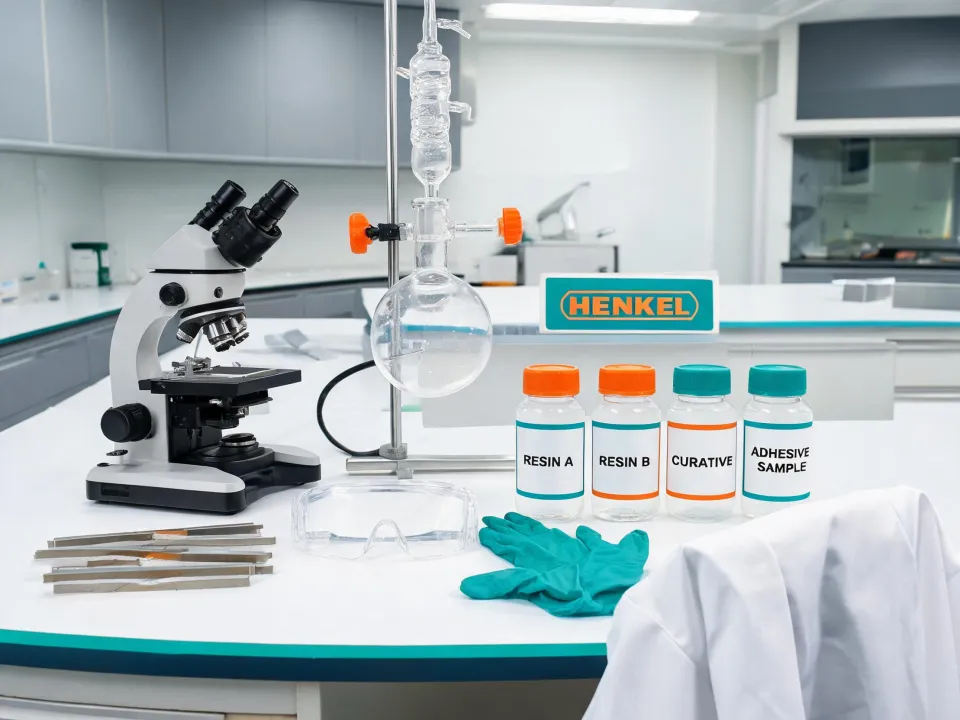
Henkel frames quality around the use case instead of claiming a single universal grade. Industrial adhesive programs need traceability, defined test methods, batch release rules, and practical storage controls. Electronics assembly may require ionic cleanliness, thermal cycling, and tighter particle control. Automotive work often adds OEM approval routes and process audits. Healthcare or pharmaceutical-adjacent work must be separated clearly from non-pharma materials, because cGMP language only belongs where the supply chain and intended use support it.
High bond strength with pot-life, glass transition, and post-cure considerations.
Flexible bonding where moisture, movement, and surface preparation decide success.
Packaging and converting options assessed by open time, tack, and thermal stability.
Rapid fixture routes for metal and plastic assemblies with aging checks.
Elastic sealing and electronics protection where temperature and chemistry matter.
Cleaner and pretreatment steps that determine downstream bond durability.
Share the chemistry family, substrate, target property, regulatory market, annual volume range, and timing. The Henkel team will route your request to the right application specialist.